Life on wheels: Tony Long’s trip down the Danube
Posted on October, 26 2015
The long-distance cyclist mantra could be "More speed, less rewards", says former WWF EPO director
Earlier this year, the former Director of WWF's European Policy Office in Brussels, Tony Long, jumped on his bike and cycled some 3,000 kilometres down the Danube -- from Donaueschingen in the Black Forest where the river rises to Sulina where it flows into the Black Sea. Read part I of the interview with him taken by Konstantin Ivanov.Why did you decide to travel down the Danube on a bike?
If you want to know the history of Europe, you have to know the Danube. That was my main motivation. At 2,880 kilometers, it may be the second longest European river after the Volga, but it wins hands down on straddling the borders of more countries. The Danube is the most multi-cultural, and probably the most cosmopolitan river in Europe.
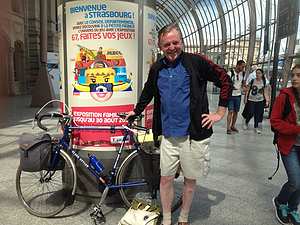
Starting the journey in Strasbourg en route (by train) to Donaueschingen
Proving that I could do it was also a personal challenge, but that became less important as the trip went on – when I began to know I could! Doing it by bike was the only way for me. The bike keeps you in contact with people. Often literally – as you wave to strangers sitting on benches outside their homes and in roadside cafés or “high-five” with kids as they rush out of their houses to greet you. The cyclist goes at pretty much the same speed and rhythm as the people, including the horse-drawn carts and fishermen you can see along the entire river. The cyclist fits into the same, slow groove and is universally regarded as a friend. Except by the occasional wild dogs!
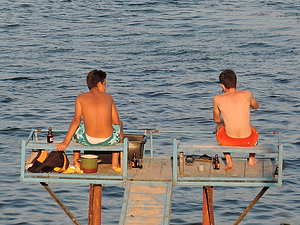
A Mark Twain moment at Vinci, Serbia
How did you prepare? What kind of bike did you use?
The bike and the rider have to fit together seamlessly on such a long trip. There can be no rough edges. I stuck to my old-time classic -- a steel frame, a British Claude Butler touring bike I bought while I worked in London in the mid-1980s (it was about 300 euro in those days), two panniers on the front, two on the back, and a Brooks saddle -- what else! This is the same bike I used to tour Norway, the Pyrenees, the Loire and the North Sea Cycle Route. Preparation must include some physical exercise. A good, but not extreme, level of fitness is surely needed. But, crucially, it is down to mental preparation also – especially stamina and determination – and good organization.
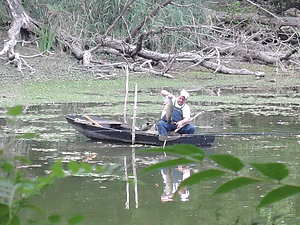
Fishing at Backi Monostor, Serbia
How much time did the trip it take? How did you break up your days of cycling?
I set aside 10 weeks to do the 3,000-kilometer trip. I could have done it in less -- certainly in eight weeks. But a shorter timescale would have meant sacrificing two of the most rewarding experiences. The first was the people I met -- the sheer pleasure of spending time with WWF friends and all the other interesting people they introduced me to along the Danube. Thank you! The second was delving deeper into unknown parts of European history through museums and exhibitions, archeological sites and battlefields, medieval cities and Roman fortresses. The long-distance cyclist mantra could well be “more speed, less rewards”.
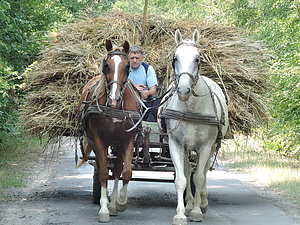
Horse-drawn hay cart near Mohács, Hungary
What did you learn about nature conservation and Danube species?
Some of what I experienced was down to good, old-fashioned luck. The fox that crosses your path early in the morning, the wild boar so startled by an unspotted cyclist that you can almost see it jumping out of its skin before ambling away, the deer in the early morning mist and the storks in their precariously perched nests on telephone poles or feeding in groups out in the newly mown hay fields.
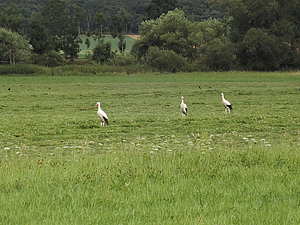
Storks at Zell, Baden-Wurttenberg
At other times, I was in the good hands of experts, for instance when searching for the ideal spawning sites of sturgeon in the Danube riverbed sub-strata exposed by the exceptionally low water levels this year; or walking through the deciduous forests on the Serbian side of the Iron Gates; or checking the camera traps placed outside a beaver lodge in the Danube Delta. Enjoying nature is another reason for making progress steadily, but slowly.
What is your best memory of WWF conservation work on the Danube?
I was moved by the life and work of a Welshman, David Reeder, in the Donau-Drava National Park at Backi Monostor in Serbia. It is close to the Hungarian and Croatian borders. I don’t recall ever meeting him while he was working as a senior adviser to the WWF DCP team or in his international career with WWF before that. But the sheer number of people talking about him and his work, completely spontaneously, almost ten years after his untimely death in 2006, made me feel connected with him. People were mentioning his name not only in WWF project areas, but in many places along the river.
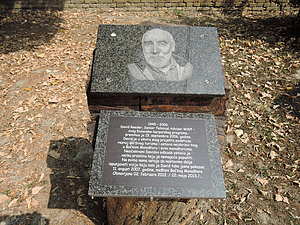
Memorial commemorating David Reeder’s life at Backi Monostor, Serbia
I tried to imagine what David would have thought of the wonderful WWF floodplain restoration project I visited at Mahmudia in the Danube Delta. Heavy earthmoving equipment is used there to create new channels that will lead to over 900 hectares of flooded polders (low lands previously separated from water bodies) and create new waterways for fishermen and new tourism opportunities for the town by linking them to inner, natural lakes and wetlands. Conservation and community development are working hand in hand there, just as David would have practiced, I imagine.
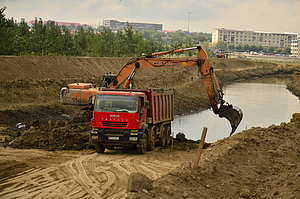
Excavators at work opening up the Mahmudia polders in the Danube delta, Romania
Read part II of this interview here.

Tony Long's 3,000-kilometre trip took 10 weeks
© Tony Long

Tony Long's 3,000-kilometre trip took 10 weeks
© Tony Long